OsloMet's strategy
The strategy will give direction for Oslo Metropolitan University towards 2050. Oslo Metropolitan University develops knowledge to solve societal challenges.
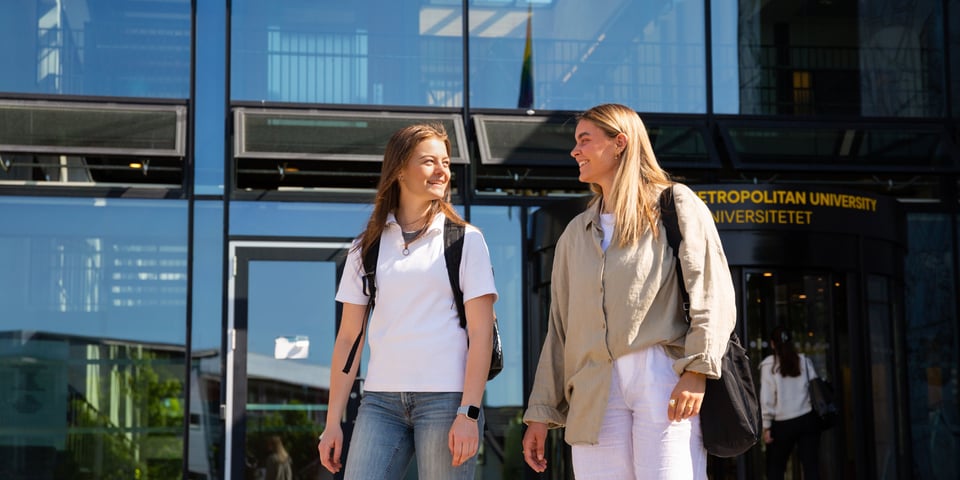
Oslo Metropolitan University – a modern university with a long history
For over 200 years, OsloMet – Oslo Metropolitan University and its predecessors have contributed to building knowledge and expertise for the Norwegian welfare society. As early as in 1818, the country’s first midwifery education started in Kristiania. Education for professions such as teaching, engineering, physiotherapy, and nursing followed. Several of these educational programmes were key in enabling women's entry into the workforce.
After the Second World War, new and important educational programmes and academic communities were established in the fields of health and social care, journalism, administration, management, and economics.
Many of our students are the first in their family to pursue higher education, and many have backgrounds from other countries. At Oslo Metropolitan University we are proud of our inclusive tradition and our contribution to shaping modern-day Norway.
Today, Oslo Metropolitan University is a modern university spanning many academic fields: from quantum physics and child welfare to journalism and cancer nursing. We are especially known for our robust and expansive academic communities within teacher education, health and social care, social sciences, design, and technology.
OsloMet is a metropolitan university where research and education are closely connected to local challenges and are enriched by the urban diversity surrounding our campuses in Oslo and Romerike. This proximity gives us unique opportunities to innovate and explore new solutions for a well-functioning society.
At the same time, Oslo Metropolitan University is internationally oriented. We participate actively in the global academic community and contribute to the generation of research-based knowledge that transcends national borders.
Oslo Metropolitan University also contributes actively to achieving the UN Sustainable Development Goals, such as eradicating poverty and halting climate change. Given the urgency of the global climate crisis, there is a heightened focus on these challenges in the coming years. Oslo Metropolitan University engages in a wide variety of academic activities linked to the sustainable development goals, with particular focus on those related to health and well-being, reduced inequality, and quality in education – often referred to as the social dimension of the goals.
Oslo Metropolitan University aspires to be a vibrant institution and a welcoming cultural meeting point and knowledge hub for the population of the city and the surrounding regions. Strongly committed to academic freedom, our university is to be a place where knowledge is developed, shared, and challenged, a place where employees are proud to work and where students thrive while developing strong academic knowledge and values. In our organisation, everyone should feel respected regardless of background and identity, and our campuses should reflect who we are, and be experienced as modern and inclusive for all.
Moving forward, Oslo Metropolitan University is committed to maintaining high quality in its educational programmes and research, and in further cultivating our academic strengths, traditions, and values.
Our values
Inclusive
We promote equality and diversity.
Innovative
We challenge the status quo and explore new ideas and solutions.
Engaged
We actively participate in and collaborate with the society around us.
Societal challenges and our commitments
The strategy will give direction for Oslo Metropolitan University towards 2050. It is therefore designed to address key long-term societal challenges and areas where we are in a position to make distinctive contributions.
These challenges include a welfare society under pressure, falling trust in science, democratic values and institutions, continued global warming, and geopolitical, economic, and technological uncertainty. Against this background, Oslo Metropolitan University aims to contribute to the following long-term goals:
- Durable welfare solutions
- A well-functioning democracy
- Sustainable development
- Expertise for an unpredictable world
The strategy is formulated as a set of commitments that articulates how the university’s academic activities will actively address societal challenges and foster societal improvements. The commitments are intended to encompass a variety of activities over time.
Durable welfare solutions
The Nordic welfare societies face challenges in the form of demographic changes, economic uncertainty, and increasing social inequality.
Immigration, an aging population, and changing economic conditions calls for the development of services to address this new reality. Education must be adapted to the changes, and there will be a need for research-based insights into how these challenges can be met.
The Nordic welfare models are based on a fair distribution of benefits, the opportunity to make informed choices, and critical discourse about priorities. There is a growing need for knowledge about the impact of social inequality on quality of life in different life phases.
OsloMet offer educational programmes and foster research communities that enable Norway to provide its population with high-quality health and welfare services.
We commit to:
- being at the forefront of research in child development, education, health, and welfare state conditions
- collaborating across professional fields and disciplines to establish a basis for good, well-coordinated services within child development, education, health, and welfare
- providing a good learning environment where students thrive academically and socially, regardless of their backgrounds
- having a prominent presence in Oslo’s boroughs and the municipalities in the metropolitan region
- setting the agenda for the public debate on social inequality and the welfare state
A well-functioning democracy
Democratic values and trust in science are being threatened in large parts of the world.
An important challenge in the coming decades will be to uphold trust in science, free access to information, and support for democratic institutions and processes both nationally and internationally. Universities are ambassadors for knowledge, openness, and democratic values. Our importance as a university is linked to the knowledge and values our students acquire through their education, to our research, and to how we engage with the society we are part of.
A well-functioning democracy needs educated professionals that offer high-quality services to a diverse population. Interactions with knowledgeable and trustworthy government employees working at the frontlines of the welfare state increase people’s trust in the democratic system. Thus, the expertise of university graduates contributes significantly to a well-functioning democracy.
We commit to:
- contributing research-based insight into democratic values and challenges
- promoting freedom of expression and open access to information both nationally and internationally
- being an open and inclusive university that encourages participation and the sharing of knowledge
- educating professionals with solid academic and ethical expertise, who are prepared to meet a diversity of people in their professional practice
- having transparent and inclusive decision-making processes, and a culture that accommodates diverse opinions and embraces constructive disagreement
Sustainable development
Sustainable development involves the interplay between nature and socioeconomic conditions and influences the natural environment, the climate, and people’s opportunities for development.
The climate crisis stands as the central challenge of our time, with ongoing global warming threatening the natural world and its resources, both in Norway and worldwide. Meanwhile, the UN predicts a world population of almost 10 billion by 2050. These challenges will affect political and economic conditions, migration, living conditions, health, and safety. How the global community addresses challenges related to the planet’s tolerance limits, food security, health, and conflicts depends on the actions taken by individual countries today, both independently and collaboratively.
As one of Norway’s largest universities, offering a diverse range of educational programmes and strategically located in and near the country’s capital, we are well positioned to make important contributions to sustainable societal development.
OsloMet is dedicated to advancing sustainable development on local, national, and international scales. This obligation/commitment encompasses our educational programmes, research communities, and entire organisation. It is crucial to gain an understanding of the complexities of sustainable development and its societal implications, while also nurturing the requisite knowledge and skills.
We commit to:
- equipping our students with professionally relevant expertise in sustainable development, enabling them to contribute effectively to solutions
- developing high-quality research on how society should deal with climate change and environmental damage, with a particular focus on its connection to socioeconomic conditions
- collaborating regionally, nationally and internationally on issues related to climate change, the environment, and sustainable development
- reducing the university’s impact on the environment and climate change
Expertise for an unpredictable world
Society relies on universities to educate students capable of adapting to an unpredictable future. Simultaneously, the university’s long-term research efforts contribute to a knowledge base that may be needed when new and unfamiliar situations arise.
The rapid development of new technologies opens doors to opportunities but also poses new challenges and threats. Oslo Metropolitan University is committed to fostering critical thinking, sound judgement, and innovation among both students and staff.
Our social responsibility extends beyond Norway. Collaborating with universities in vulnerable areas and safeguarding vulnerable researchers and students are part of our global social responsibility. In times of crisis, maintaining contact with academic communities across national borders is crucial to safeguarding knowledge institutions and their vital roles.
We commit to:
- teaching our students critical thinking, how to be creative and how to exploit new technologies
- advancing knowledge development through long-term research that provides a foundation for addressing new and unforeseen challenges
- collaborating on academic activity with academic communities in countries and regions experiencing war, conflict, and crisis
- working closely with local communities to develop emergency preparedness for various forms of crises and conflicts
- fostering innovation that helps solve challenges in collaboration with relevant communities
- being internationally orientated and valuing the knowledge and experiences brought to us by our students and employees from other countries and regions