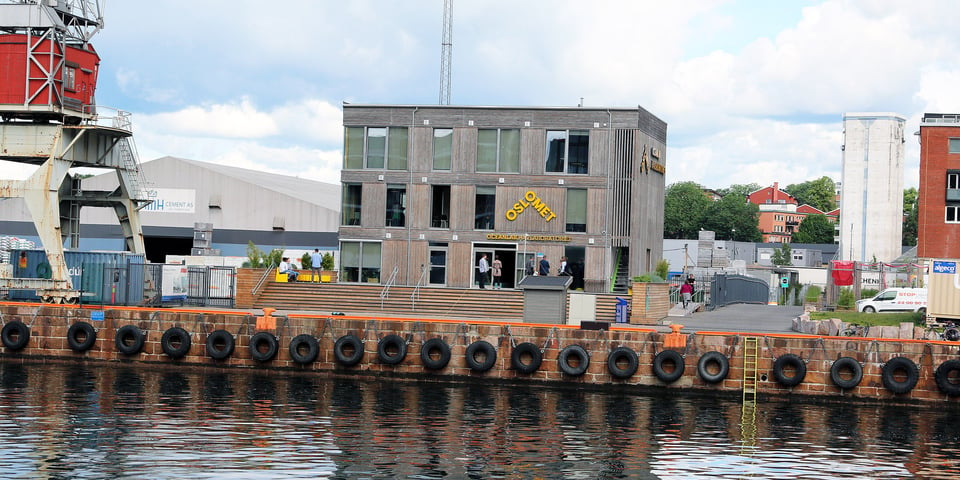
The establishment of Oceanlab is a result of OsloMet's focus on urban oceans and its interdisciplinary commitment to innovation for sustainability. The concept of urban oceans is about seeing ocean and marine resources in relation to urban life and urban development.
OsloMet will contribute to knowledge about the ocean, water and marine resources by developing technology that collects data. In the OASYS project, miniature underwater robots are being developed to collect data from the ocean.
Underwater robots – so-called miniature under water gliders (MUG) – helped by drones and self-propelled surface vessels, can do this at a far lower cost, in a more environmentally friendly manner, and without posing a risk to people.
The earth’s oceans are under serious threat due to over-exploitation, pollution and climate change, and the harmful effects of irresponsible and unsustainable growth.
Artificial intelligence and automated (autonomous) systems can give us ‘a pair of eyes’ beneath the surface of the ocean to make it easier to detect pollution with more accurate data.
The research project OASYS is funded by the Research Council of Norway, the German Federal Ministry for Economic Affairs and Energy (BMWi) and the EU Commission under the framework of ERA-Net Cofund MarTERA.
The Filipstad area has been designated as a focus area for “Innovasjonsdistrikt Sentrum” (City centre innovation district), in which Oceanlab will be a central arena for collaborating on research, building networks and innovation.
“Innovasjonsdistrikt Sentrum” is a collaboration between OsloMet, the City of Oslo, Arena Oslo and other partners.