Looking at the urban planning of the future
‘When we look at how sustainable cities can be built using smart transport solutions, we feel we’re helping to shape the future.’
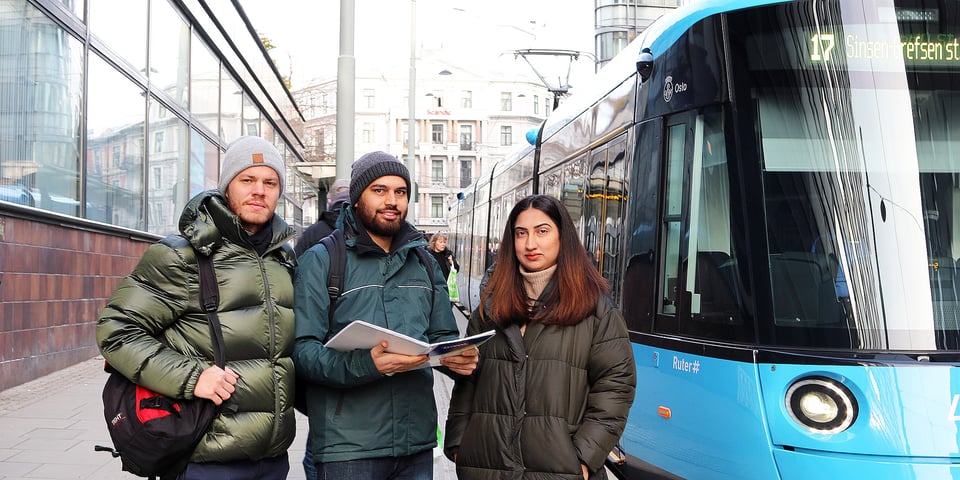
The very first students have started the new master's degree programme Smart Mobility and Urban Analytics.
The students gain an insight into new technology and are met with great interest from large companies that work with urban and transport planning.
The topic of sustainability is in the air, and the students are looking at the future of urban planning.
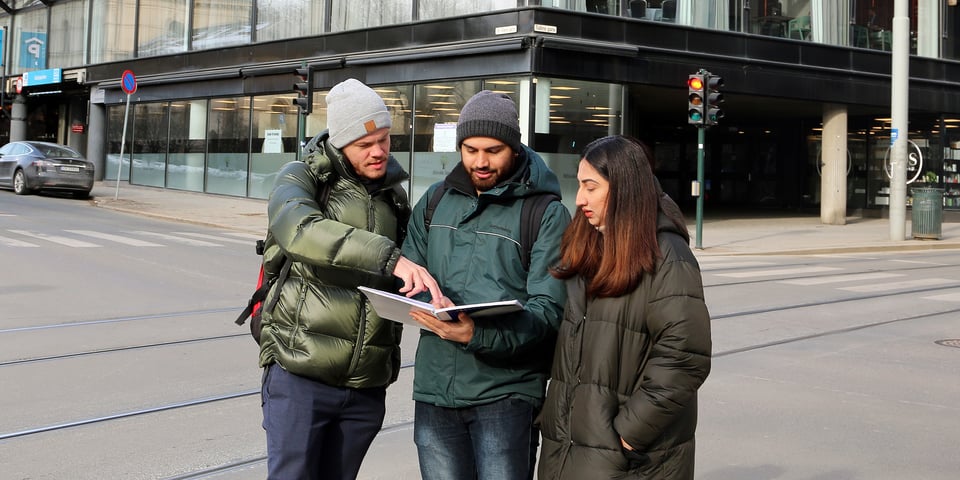
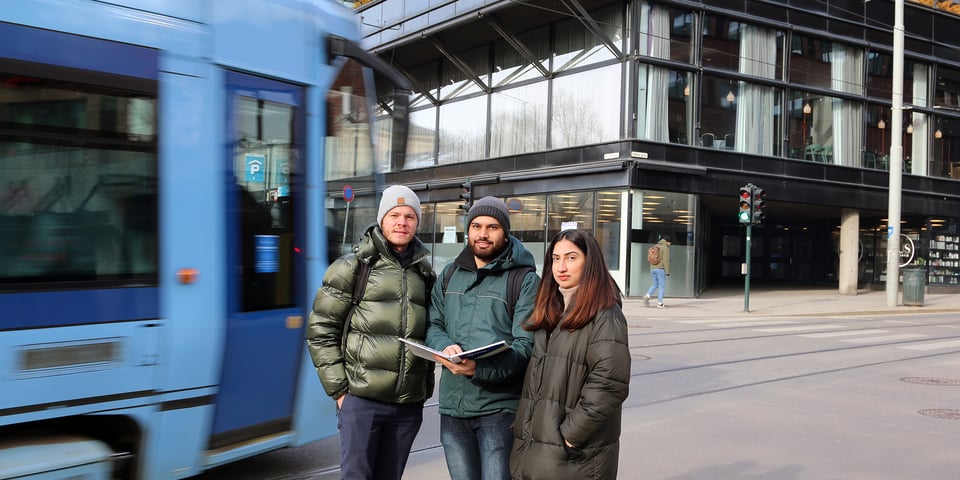
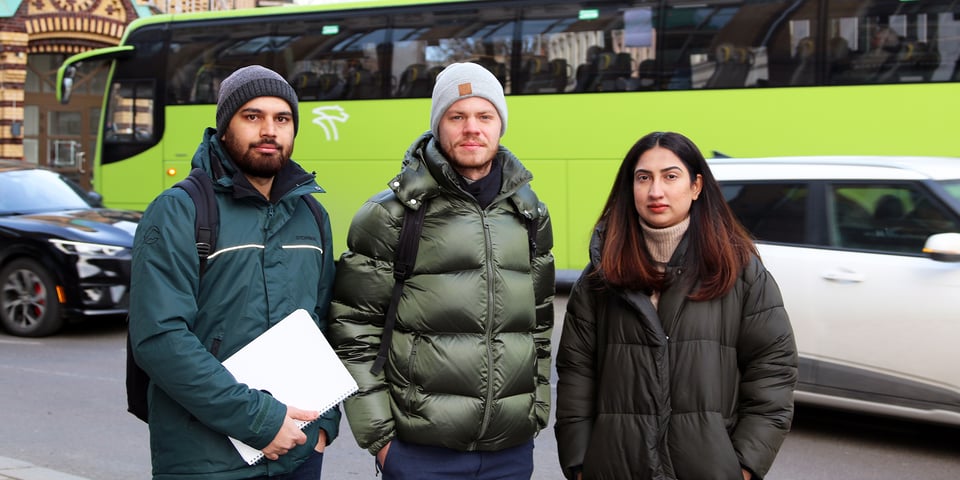
We met with master's degree students Syeda Amna Fatima, Asim Lamsal and Markus Emanuel Wehrmeister Tonjer.
Working closely with current projects
It wasn’t long after starting their studies that the students had contact with the business world. They were asked to start using software that will be of great benefit in the future, and have worked closely with their teachers, who are very attentive to their needs.
‘We’ve had contact with highly respected companies and have looked closely at their current projects,’ says Asim.
This was made possible with the help of guest lecturers and external collaborations and networks.
In the first semester, the students were given a comprehensive introduction to the field of study.
‘Starting on this master’s programme has been a great experience. I received excellent help from the teachers to get me started,’ says Amna.
New technology and innovative solutions offer great opportunities
‘The most exciting aspects are new technology and new ideas. There is a lot of discussion about sustainability and the use of new technology and innovation in transport solutions and in the human-made environment of a city. There is an extensive demand for expertise,’ says Asim.
‘We feel that we’re helping to shape the future. We’re looking closely at what cities will look like in the future, and the ways in which we can move around them,’ continues Markus.
‘We see how companies have made changes and modelled solutions using the same digital tools that we’re learning to use.
This will help us to become specialists in planning sustainable cities with smart transport solutions,’ adds Asim.
‘Based on what the guest lecturers have said, we will have a lot of employment opportunities in the future,’ emphasizes Amna.
Rooted in civil engineering, landscape planning and architecture
The students have different backgrounds from their bachelor's studies, but all their degrees have relevance to the master's programme.
‘I was interested in transport engineering and wanted to learn more about urban planning. I already had a bachelor's degree in civil engineering and wanted to specialise in transport planning and urban planning,’ tells Asim.
‘I came from the other end of the spectrum and had studied landscape planning at quite a detailed level. I realised it might be better to zoom out a bit and work with urban planning on a slightly larger scale,’ continues Markus, who previously studied at Western Norway University of Applied Sciences (HVL).
‘I took my bachelor's degree in building architecture engineering in Pakistan. I was recommended to take a Scandinavian degree to improve my job and career opportunities. I have family here and didn’t want to leave Oslo,’ adds Amna.
The students believe that having a master's degree is a huge advantage when working in this field in Scandinavia, especially for anyone wanting to work in the big cities.
‘When I applied for a job, they wanted me to be more specialised in projects. That’s one of the main reasons I chose to take this master's programme at OsloMet. I wanted this qualification and also wanted to study in the centre of Oslo,’ says Asim.
A recommended master's programme
‘Would you advise others to take this master's programme?’
‘Yes, definitely. As the first students on the programme, it is been rather a special journey for us,’ Markus points out.
‘Considering the jobs market, it is an excellent choice. It would be great for anyone wanting to learn more about planning smart mobility solutions in a city, and how political decisions affect the way we move around the city,’ emphasizes Markus.
‘I also think it is a good choice when it comes to the jobs market,’ concludes Amna.
Based on our experience so far, and what we’ve heard from potential employers, we would definitely recommend the programme.
Many choices in urban planning
‘There’s a broad range of subject areas. We don't all have to follow the same line of study. There are many different possibilities,’ underlines Markus, who would advise new students to be open, inquisitive and on the lookout for opportunities when they start the programme.
‘Urban planning is complex. There are so many topics that can be studied in more detail.’
Students can shape their education by taking the initiative.
Markus and Amne focus on urban planning, while Asim focuses on transport planning and mobility.
A great deal of innovation and new thinking is required.
‘The plans to banish cars from city centres require sustainable solutions. They require new thinking from young people with different mindsets. More people are needed to help shape the future cities,’ says Markus.
We’re in demand
‘It is wonderful to have already been offered a summer job related to smart mobility in one of the big companies and to hear them say there’s a huge demand for people like us. People who understand urban planning and know about smart mobility,’ says Asim.
‘There’s great potential in the jobs market, both in the public and private sector.’
‘While considering the vast array of employment opportunities, we also need to choose which line of study to follow.’
Insightful courses
The students talk about some of the courses they are taking in the spring semester.
‘We will have a course on geographic information systems (GIS), in which we will learn the GIS software. We will also have a course on inclusive, sustainable, and smart cities, and one on transport modelling and analysis,’ says Amna.
'The courses in the first semester were fairly general. In the second semester, we focus a bit more, based on what we want to specialise in, in the third semester,’ says Asim.
In the third semester, the students can specialise in ‘Space Syntax’, which provides in-depth knowledge into how complex architectural and urban systems work and how urban spaces can be planned, designed, and arranged to contribute to a better society.
They can also specialise in ‘urban mobility’, which provides in-depth knowledge of land use and transport planning that meets the need of smart and sustainable cities.
In the fourth semester, students will work on their master's thesis.
At the top of the article you see Markus (left), Asim and Amna in Holbergs plass with the new Oslo tram on the right.
More about life in Norway
- Life as a student
A guide to making friends with Norwegians
While befriending the locals may take a little extra effort, it can help you experience Norway from a whole new perspective.
- Life as a student
Eight ways to experience Norwegian culture in Oslo
Embrace the great outdoors, sample the local cuisine, and hang out with friends at a safe distance. Here are some ways to spend your free time like the locals do.
- Life as a student
Find your happy place in one of Oslo's many parks
“I like a lot of places in Oslo. But if I had to choose, my first choice would be Frognerparken," says Herish, a master's student from Iran.
- Life as a student
Oslo has the perfect mix of city and nature
“In Oslo you can go hiking in the woods during the day and go out partying in the evening, ” says Julia, an exchange student from Germany.
- Life as a student
Oslo is not as expensive as you think
The rumours are true—Norway is a relatively expensive country. On the other hand, you will end up spending less on some things in Oslo than you would back home.