Making battery replacement easier for drones
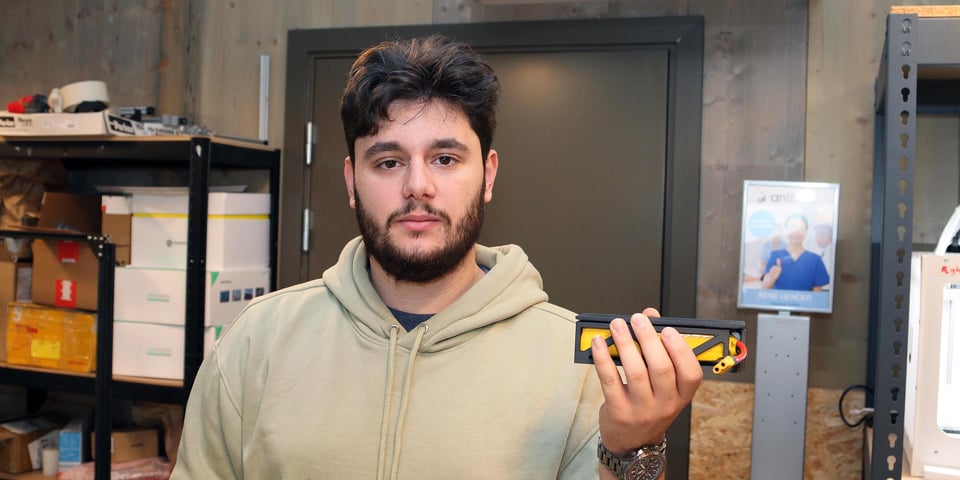
Master's student Giorgio Salvemini wants to greatly enhance the efficiency of drones by enabling them to automatically switch to fully charged batteries.
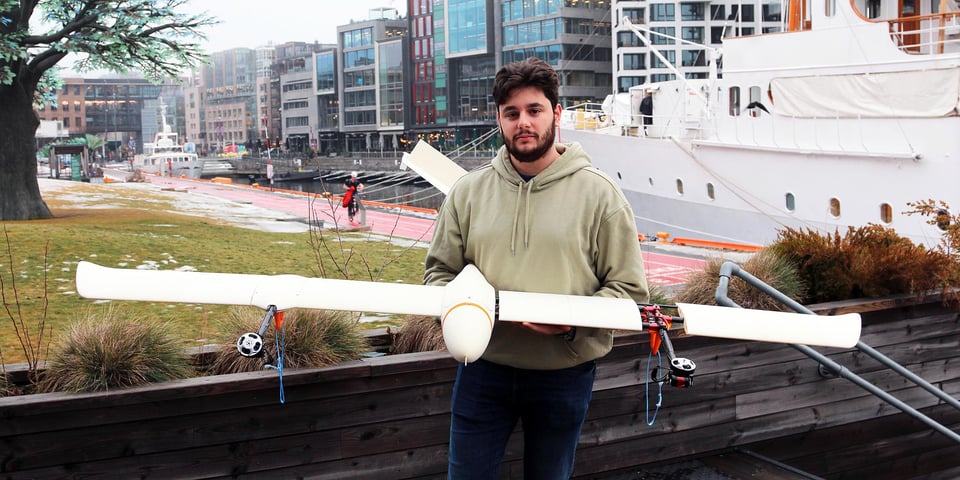
In his master's project at OsloMet, Giorgio is developing an automated battery replacement system that could streamline the operation of unmanned aerial vehicles (UAVs) and eliminate the need for human intervention during battery swaps.
Drones are increasingly used in various sectors, from search and rescue operations to surveillance of power lines, forests, and marine areas.
However, they face a significant limitation in battery life. The necessity for a human operator to manually switch to charged batteries is time-consuming, costly, and restricts the drone's flight time and capacity.
Giorgio's project aims to solve this problem.
"Having an automated system to do this for you would primarily reduce the need for manual labour by humans, meaning the drone can be operated faster and more efficiently, and its flight range can be increased. This would enable the drone to have much more continuous operating time than today's drones," he explains.
A landing platform that changes batteries
While automated battery replacement systems have already been developed for certain types of drones, there are none for the type Giorgio is working on – a fixed-wing, tilt-rotor, VTOL quadcopter, which can take off and land vertically but flies like a regular aeroplane.
The solution he is developing involves a landing platform that extracts the used battery, puts it on charge and inserts a fully charged battery – all without human intervention.
When we spoke to him, Giorgio was working on the process for removing and inserting the battery.
“I am focusing on developing a customised solution that will use actuators and motors to remove the battery, charge it, and in a way ‘rotate’ out a charged battery, which is inserted into the drone.”
The next step will be to develop a casing to secure all the hardware, enabling the drone to land, swap batteries, and continue its mission under various weather conditions.
Aiming to build a functional prototype
Giorgio aims to have a functional prototype built by the end of the semester. He has access to most of the necessary tools, including those at OsloMet Oceanlab, and can order additional resources through his supervisor, Professor Vahid Hassani, if needed.
The project is led by Department of Mechanical, Electrical and Chemical Engineering OsloMet, and Giorgio believes it could have practical applications once he has developed the prototype and might even be patented.
Recommending the practical approach at OsloMet
Giorgio completed his bachelor's degree in Electrical Engineering at OsloMet before starting his master's specialisation in Robotics and Control.
He praises the practical learning methods used at OsloMet, and especially enjoys the practical part of his specialisation involving laboratories where one can test and check how the theory actually works.
Giorgio believes his work on drone technology demonstrates the innovative and practical learning method that OsloMet promotes, and he would therefore like to recommend the university to others.
For those considering the same education, Giorgio advises taking studies seriously from the outset and developing good work habits early in the course. He also emphasises the importance of utilising available resources and building strong relationships with lecturers.
A passion for electronics
However, he believes that having a passion for what you study is the most important factor.
"I have developed a passion for electronics and programming that I wouldn't have had the chance to explore if I hadn't started studying here," he says.
With his master's project well underway, Giorgio also has a career plan. He recently applied for a PhD project, hoping to continue his educational journey in Robotics and Control.
Giorgio's story is an example of how OsloMet students exploit the opportunities they are given to make progress in their field. With his work in drone technology, he also sets an example of what OsloMet students can work on.
Student stories
- Technology and design
How Tawfique aims to enhance the production of biogas
Master's student Tawfique is interested in how control engineering can be utilised within renewable energy., and explores this in Norway's largest wastewater treatment plant.