Mathematical Modelling and Quantum Technologies
Master's degree
Become an expert in developing and simulating mathematical models, and learn how quantum computers work.
Master's degree
Become an expert in developing and simulating mathematical models, and learn how quantum computers work.
To apply for this programme you must have one of these:
You must also have:
Applicants will be ranked on the basis of grade average from their bachelor's degree.
You apply via Søknadsweb, where you fill in your details and upload all the required documents.
There are different application deadlines based on which country you apply from:
For students from the EU/EEA/EFTA the only cost of this programme is the semester fee (student.oslomet.no) of approximately NOK 1,000, which you pay each semester of the programme. For these students there are no tuition fees.
Mathematics is crucial in describing the world around us. Engineering, physics, economics and meteorology are examples of disciplines where mathematicians work side-by-side with specialists to convert real phenomena into equations.
By translating these equations into program code that can be run on a computer, we can generate simulations to be used, for example, in weather or economic forecasts. Quantum computers can potentially perform these computations much faster than the best computers do today.
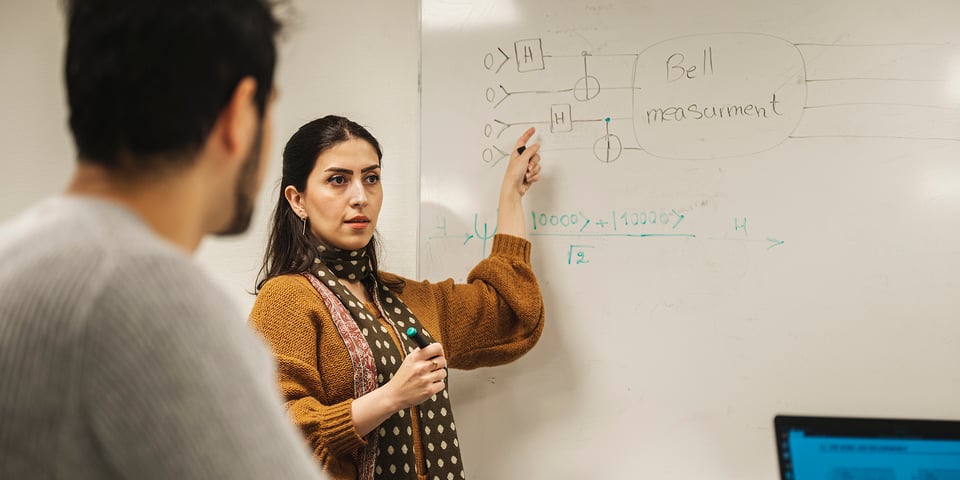
In this specialization you will develop mathematical models, analyse and simulate the models and learn how quantum computers work.
The specialization prepares you to develop and process models in your own projects, and for jobs in research, industry and IT, where mathematical modelling and simulation are essential.
You will be able to implement mathematical models and computational methods on a computer, run numerical simulations and interpret simulation results. And you will know how to implement some algorithms on a quantum computer.
In short, you will possess cutting-edge expertise on quantum technology, a technology that could potentially revolutionize IT.
You write a master's thesis of either 30 or 60 credits, where you get time to immerse yourself in ongoing research at OsloMet, or work on a concrete and limited project of your own choosing.
All courses are taught in English.
The programme focuses on active forms of learning where you learn advanced theory through the practical use of technology.
You will be expected to take responsibility in your studies, because a completed Master's degree must be proof of a good ability to work independently. Therefore, the study's teaching is more closely organized at the beginning than towards the end, where the choices and responsibility rest to a greater extent on you as a student.
You will have a variety of
This overview shows all the specialisations in the Master's Degree Programme (MSc) in Applied computer and Information Technology. The subjects in Mathematical Modelling and Quantum Technologies are listed per academic year under the heading "Mathematical Modelling and Scientific Computing".
This overview is updated each spring, and until then it shows the courses available to current students.
You can go on exchange in the third semester.
The specialisation in Mathematical Modelling and Quantum Technologies produces qualified senior professionals to both public and private sector, for example consulting engineers, and professionals in innovation and development.
With your competence in mathematical modelling and expertise in quantum technology, you will be qualified for jobs within research and development, industry and in the IT sector where computation and simulation are key components. Due to your solid knowledge of mathematics, you will also be able to work within teaching.
It is not uncommon to get positions such as manager, team leader, subject manager or project manager after a few years.
As a technologist, you are not tied to a particular sector or industry. Technologists work in health, education, entertainment, public transport and almost every other conceivable part of society.
An advantage of studying technology is that you don't have to decide which sector you want to work in from the start. You can change paths during your career.
The degree also qualifies for PhD programmes, depending on your specialization and grades.