Created by potrace 1.11, written by Peter Selinger 2001-2013
NO
Search oslomet.no
  • About OsloMet
  • Study at OsloMet
  • Our research
  • Work for us
  • Alumni
  • University Library
  • Contact us
  1. OsloMet
  2. ...Intermediate levels are hidden
  3. Study programmes and courses
  4. MA Mechanical Engineering

Mechanical Engineering

Master's degree

Learn about the fundamentals of solid mechanics, fluid mechanics, and mechatronics with applications in green energy, design, robotics, offshore, and oil and gas.

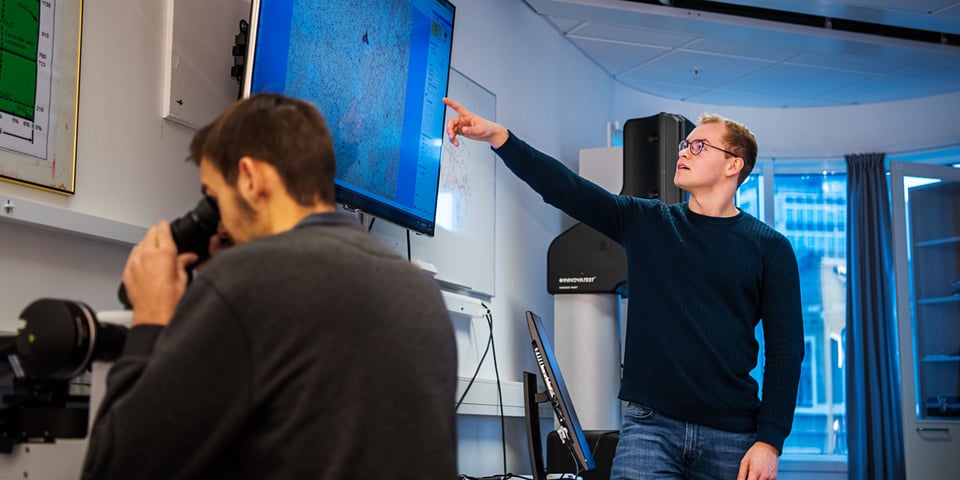
A master's student in Mechanical Engineering at OsloMet points at a screen while another student looks through a microscope.
Study location
Pilestredet i Oslo
Duration
2 år
Scope
Heltid
Credits
120
Study start
Høst
Teaching language
Engelsk
Study places
40
Programme description
  • See programme description

Exchange

Further studies at OsloMet

  • PhD Engineering Science

    • PhD
    • 3 år
    • Heltid

Academic Coordinator

  • Ramis Örlü

    Ramis Örlü

    • Professor
    • +47 672 36 142

Campus

  • Pilestredet Campus

Questions about studying at OsloMet

You can  with any questions about studying at OsloMet, applying and life as a student.

If you have specific questions about the degree you can .

You might also be interested in

  • MA Civil Engineering

    • Master's degree
    • 2 år
    • Pilestredet i Oslo
    • Heltid

Student stories

  • Image of a hand touching equipment in the machine laboratory at OsloMe

    OsloMet launches a master's programme in mechanical engineering

    OsloMet launches a Master of Science programme in mechanical engineering in 2024. The new master has a particular focus on sustainable technology.

  • Julia sitting in front of a graffiti art wall.
    • Life as a student

    Oslo has the perfect mix of city and nature

    “In Oslo you can go hiking in the woods during the day and go out partying in the evening, ” says Julia, an exchange student from Germany.

  • Three students walking along a quiet street with small wooden houses. Photo: Benjamin A. Ward.
    • Life as a student

    Want to enrich your stay in Oslo? Learn Norwegian!

    By learning some Norwegian, you’ll become more integrated into Norway’s culture and begin to discover Oslo in a whole new way.

  • Seaside in the centre of Oslo, a small leisure boat on the fjord and people soaking in the sun on land.
    • Life as a student

    Where to live in Oslo: your guide to the best student housing

    As an international student, one of the most important decisions you make before coming to Norway is where to live—a choice that will have a significant impact on your experience in Oslo.

More student stories

OSLO METROPOLITAN UNIVERSITY
STORBYUNIVERSITETET

P.O. Box 4, St. Olavs plass
NO-0130 Oslo
Norway
Tel.: +47 67 23 50 00

Contact us

  • Facebook
  • LinkedIn
  • Instagram
  • Norwegian
  • Accessibility statement
  • Cookies policy
  • Employee directory
  • Employee website
  • Student website
  • Upcoming events
  • Work for us

Semester start

  • Information about semester start for Mechanical Engineering students (student.oslomet.no).
  • General information about semester start at OsloMet (student.oslomet.no).

Admission requirements

To apply for this programme you must have one of these:

  • a bachelor's degree in Engineering (Mechanical, Aeronautical, Aerospace, Civil, Mechatronics/Robotics or Energy and Environment in Buildings) or a bachelor's degree in Applied Mathematics or Physics, at least 25 ECTS in mathematics (excluding statistics) and 5 ECTS in statistics
  • a bachelor's degree in Engineering in the disciplines of Electronics, at least 25 ECTS in mathematics (excluding statistics),  5 ECTS in statistics and 15 ECTS in solid mechanics, fluid mechanics and mechatronics
  • a bachelor's degree in Engineering in the disciplines of Chemistry or Biotechnology, at least 25 ECTS in mathematics (excluding statistics), 5 ECTS in statistics and 21 ECTS in solid mechanics, fluid mechanics and mechatronics

You need an average grade of at least C (according to the ECTS grading scale) on your bachelor's degree.

You also need one of the following:

  • English from a Norwegian or Nordic upper secondary school and a bachelor's degree from Norway or the Nordic countries
  • at least 4 in English from Norwegian upper secondary school
  • proof of your English proficiency

More about admission to master's programmes.

How to apply

You apply via Søknadsweb, where you fill in your details and upload all the required documents.

Application deadlines:

  • 1 November: for applicants from countries outside of the European Union / the European Economic Area (EEA) / Switzerland
  • 1 March: early admission for applicants from the European Union, the European Economic Area (EEA) and Switzerland, and for non-EU/EEA citizens with a Norwegian national ID number residing in Norway
  • 15 April: ordinary admission for applicants from the European Union, the European Economic Area (EEA) and Switzerland, and for non-EU/EEA citizens with a Norwegian national ID number residing in Norway

Programme cost

For students from the EU/EEA/EFTA the only cost of this programme is the semester fee (student.oslomet.no) of approximately NOK 1,000, which you pay each semester of the programme. For these students there are no tuition fees.

For students from countries outside the EU/EEA/EFTA there are tuition fees in addition to the semester fee (student.oslomet.no).

Programme content

The Master’s Programme in Mechanical Engineering will train you to adopt new technology and develop innovative and sustainable solutions in, for example, green energy sources, machine design, health technology, robotics, offshore and underwater technology, fisheries, and oil and gas.

This requires multidisciplinary expertise, and this programme is unique in that it provides broad knowledge and competence.  

Engineering physics and mathematical principles are combined in the mechanics of solids and fluids, thermodynamics, materials science, design, structural analysis and electricity. 

The programme consists of nine courses in total, seven of which are compulsory and two of them elective. All courses consist of 10 ECTS credits. In addition, there is a master’s thesis of 30 credits. 

You must first complete the compulsory courses and then specialise in either solid-state mechanics, fluid mechanics or mechatronics through the choice of elective courses and the MSc thesis. 
How the programme is taught

You will have a variety of  

  • lectures 
  • practical laboratory and computer laboratory work 
  • project work 
  • written presentations, reports and oral presentations 
  • teamwork 

Programme structure

This overview shows the structure of the programme. It is updated each spring, and until then this overview shows the courses available to current students.

Year 1

Fall 2026
Compulsory courses
Courses Fall 2026
CourseCourse codeCreditsType
Advanced Engineering MathematicsMECH400010 ECTSCompulsory
Continuum Mechanics and ThermodynamicsMECH410110 ECTSCompulsory
Introduction to Mechatronics MECH420110 ECTSCompulsory
Spring 2027
Compulsory courses
Courses Spring 2027
CourseCourse codeCreditsType
Advanced MaterialsMECH410210 ECTSCompulsory
Finite Element MethodMECH410310 ECTSCompulsory
Practical Mechatronics MECH420210 ECTSCompulsory

Year 2

Fall 2027
Compulsory courses
Courses Fall 2027
CourseCourse codeCreditsType
Computational Fluid DynamicsMECH430110 ECTSCompulsory
Elective courses
Courses Fall 2027
CourseCourse codeCreditsType
Rehabilitation and Assistive TechnologyACIT403510 ECTSMinimum two
Applied Robotics and Autonomous SystemsACIT482010 ECTSMinimum two
Structural Integrity and ImpactMECH410410 ECTSMinimum two
Sustainable design and manufacturing of energy systemsMECH410510 ECTSMinimum two
Advanced Fluid MechanicsMECH430210 ECTSMinimum two
Spring 2028
Compulsory courses
Courses Spring 2028
CourseCourse codeCreditsType
Master ThesisMECH590030 ECTSCompulsory

Outgoing mobility

You can go on an exchange during your third semester or while you write your master’s thesis in fourth semester.

Find exchange opportunities (student.oslomet.no).

Incoming mobility

If you want to add an international dimension to your educational path by spending a mobility period abroad, OsloMet is pleased to welcome you. You should select courses counting for at least 30ECTS if you intend to stay for one semester, and 60ECTS if you intend to stay for two semesters.

Find further information about the available courses and how to apply.

Career

This programme will qualify you for jobs in industry and the public sector. 

Examples of relevant jobs could include:  

  • Designer and analyst in solid mechanics, for example stress analyst, FE specialist, stress mechanical engineer in oil and gas, and engineer in functions related to wind energy, defence, acoustics, robotics, medical engineering and automotive.
  • Design engineer and analyst in fluid mechanics, theoretical and computational fluid dynamics expert, and experimentalist in oil and gas, aerospace, defence, subsea, hydraulics and diving.  
  • Designer and analyst in mechatronics and robotics, mechanism designers, machinery operator, and control system analyst and maintenance officer in medical robotics, automation and autonomous subsea systems.  
  • Consultant, adjunct supervisor and advisor to government boards and private companies, policy advisor and situation analyst.  
  • Project leader, principal, and top managerial functionary in public or private sectors related to associated industrial sectors.  
  • Project leader, governmental or municipal official for infrastructure and production plants.  
  • Researcher within solid mechanics, fluid mechanics or mechatronics.