Created by potrace 1.11, written by Peter Selinger 2001-2013
NO
Search oslomet.no
  • About OsloMet
  • Study at OsloMet
  • Our research
  • Work for us
  • Alumni
  • University Library
  • Contact us
  1. OsloMet
  2. ...Intermediate levels are hidden
  3. Study programmes and courses
  4. MA Product Design and Culture

Product Design and Culture

Master's degree

Great products make everyday life better. Today's product designers need competence in creativity, aesthetics and understanding of cultural contexts and commercial markets and value.
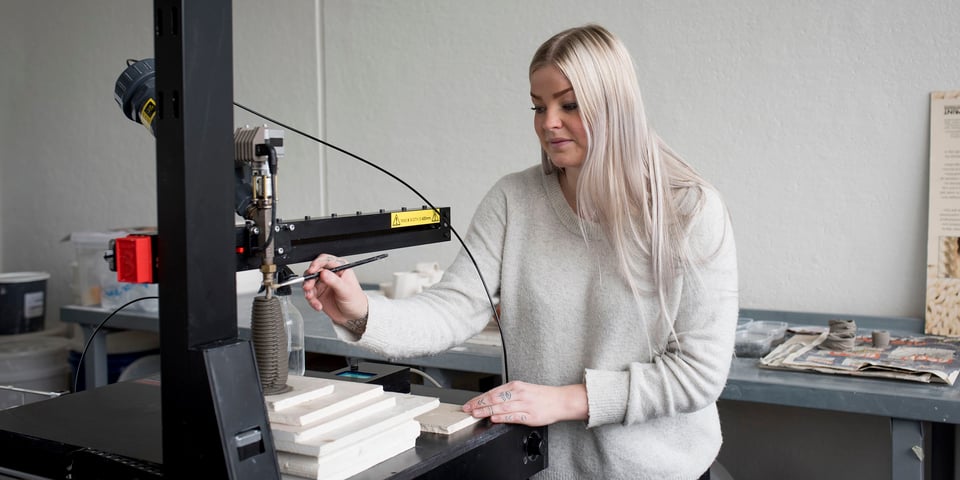
Female student painting something made by a clay 3D-printer
Study location
Kjeller i Lillestrøm
Duration
2 år
Scope
Heltid
Credits
120
Study start
Høst
Teaching language
Engelsk
Study places
20
Programme description
  • See programme description

This specialisation prepares you to design for the shift towards sustainable societies, through theory and design methodology for product design in various cultural contexts. 

Product Design and Culture is a specialisation in the Master’s Degree Programme in Product Design – Design in Complexity.

Further studies at OsloMet

  • PhD Innovation for Sustainability

    • PhD
    • 3 år
    • Pilestredet i Oslo
    • Heltid

Academic coordinator

  • Anna Talbot

    Anna Talbot

    • Head of Studies
    • +47 672 38 253

Campus

  • Kjeller Campus

Student stories and news

  • Girl doing crafts in a classroom
    • Art and design

    It takes courage to create

    Resistance and obstacles are needed to unlock creativity, according to Arild Berg, artist and professor at OsloMet.

  • Nadiya, fellow student Elias, and Mari
    • Technology and design

    Solving future challenges with design

    "Product design is exciting: You don’t have to stick with one thing, you work across disciplines and I think that’s the way everyone should work", says Nadiya.

  • Rob Starling standing in the stairs of a tall building.
    • Technology and design

    Design students aim to solve problems and improve people’s lives

    Rob Starling chose OsloMet for his master’s degree in product design because he wanted to expand his digital toolkit and explore the department’s impressive workshop facilities. Now he has embarked on a whole new career within service design.

  • The students sit and stand around on the grass, out in the yard of the farm. We are seeing tools and machines. In the background we see a storehouse and a barn..
    • Technology and design

    An experience of a lifetime!

    The international product design students at OsloMet got off to a flying start with a three day excursion in August.

More student stories

OSLO METROPOLITAN UNIVERSITY
STORBYUNIVERSITETET

P.O. Box 4, St. Olavs plass
NO-0130 Oslo
Norway
Tel.: +47 67 23 50 00

Contact us

  • Facebook
  • LinkedIn
  • Instagram
  • Norwegian
  • Accessibility statement
  • Cookies policy
  • Employee directory
  • Employee website
  • Student website
  • Upcoming events
  • Work for us

Semester start

  • Information about semester start for Product Design students (student.oslomet.no).
  • General information about semester start at OsloMet (student.oslomet.no).

Admission requirements

To apply for this programme you must 

  • have a bachelor’s degree or equivalent, including at least 80 ECTS within the field of design
  • have an average grade of at least C according to the ECTS grading scale on your bachelor's degree
  • upload a portfolio consisting of documented design works related to products, systems or services
  • upload a motivation letter that includes 
    • your interest in the field of study
    • your previous experiences that prepare you for this master programme
    • your unique motivation for what you want to achieve by joining this programme
    • why your previous degree is relevant to this master programme
    • your thoughts on how you can use this in your future career

You also need one of the following:

  • English from a Norwegian or Nordic upper secondary school and a bachelor's degree from Norway or the Nordic countries
  • at least 4 in English from Norwegian upper secondary school
  • proof of your English proficiency

More about admission to master's programmes.

How to apply

You apply via Søknadsweb, where you fill in your details and upload the required documents.

There are different application deadlines based on which country you apply from:

  • 1 November: for applicants from countries outside of the European Union / the European Economic Area (EEA) / Switzerland 
  • 1 March: ordinary admission for applicants from the European Union, the European Economic Area (EEA) and Switzerland, and for non-EU/EEA citizens with a Norwegian national ID number residing in Norway

Deadlines for uploading portfolio and motivation letter:

  • 1 November: deadline for uploading to Søknadsweb for applicants from countries outside of the European Union / the European Economic Area (EEA) / Switzerland 
  • 5-15 March: period for submitting portfolio and letter of motivation for applicants from the European Union, the European Economic Area (EEA) and Switzerland, and for non-EU/EEA citizens with a Norwegian national ID number residing in Norway

Programme cost

For students from the EU/EEA/EFTA the only cost of this programme is the semester fee (student.oslomet.no) of approximately NOK 1,000, which you pay each semester of the programme. For these students there are no tuition fees.

For students from countries outside the EU/EEA/EFTA there are tuition fees in addition to the semester fee (student.oslomet.no).

Mandatory course for new OsloMet students

The Master of Product Design at OsloMet requires all students to be Health, Security, and Environment (HSE) certified to access the various workshops. This course is mandatory and will be held the week before the start of the fall-semester. For students who have been certified in the Bachelor of Product Design at OsloMet it is not necessary to attend.

The course is held at the Department of Product Design at Kjeller Campus.

Programme content

The programme focuses on design theory and methods that explore how communication can be achieved through aesthetics and material samples. It emphasizes advanced design practices that reflect cultural awareness in diverse contexts.

Upon completing the programme, students will be equipped to lead and carry out product design projects that address complexity in various cultural settings. This complexity includes social, political, environmental, economic, and technological factors that influence both the designer and the products or services they create.

The specialisation provides practical experiences such as hands-on workshops, fieldwork, and interview techniques grounded in design methods. Students are encouraged to engage in discussions about cultural heritage, developing an understanding of how design both shapes and is shaped by culture. The curriculum involves creating, collecting and analysing data, as well as effectively presenting and communicating findings.

How the programme is taught

Teaching can consist of:

  • Lectures
  • Workshops
  • Discussions
  • Presentations
  • Self-study
  • Practical work
  • Tutoring

Programme structure

This overview applies to current students. The updated course structure for all three specializations will be published by March 15, 2026.

Year 1

Fall 2026
Studieretning

Select an option to see courses.

You can choose between:

  • Product Design and Culture
  • System and Service Design
  • Design for Healthcare and Wellbeing

Exchange

During the second and third semester, the students might have the option to spend a semester abroad at one of the universities OsloMet has an agreement within a variety of countries.

Find exchange opportunities (student.oslomet.no).

Career

In the specialisation for product design and culture you learn to take a range of roles as a designer. You will be the facilitator and the project leader of developing strategies, services, and product solutions. 

The skills, knowledge and insights you attain concerning cultural awareness in your user oriented approach are regarded as valuable both in the private and public sector, as well as for design research. 

The specialisation emphasises collaboration, providing opportunities for students to work with external collaborators. This allows students to understand the context of their designs, enhancing their ability to create products that are not only aesthetically pleasing but also sustainable and culturally relevant.

Graduates can pursue various career paths, including product designer, innovation consultant, entrepreneur and design strategist. They may also work in sectors such as technology, manufacturing, and sustainability, addressing real-world challenges through design.

Questions about studying at OsloMet

with any questions about studying at OsloMet, applying and life as a student.

If you have specific questions about the degree .

Social media and graduation exhibition

Follow us on Instagram @oslometproduktdesign.

Bachelor's and master's digital graduation exhibition (productdesignarchive.com).