Stroke: Digital tools can provide equally effective rehabilitation at home
This paves the way for a more flexible future for patients.
Kort oppsummert
- Digital tools can enhance self-management, provide rapid access to quality-assured information and facilitate contact with healthcare professionals, thereby increasing a sense of security and control during rehabilitation.
- Organised digital home-based exercise can be just as effective as hospital-based exercise, allows for more frequent sessions at one’s own pace, and is perceived as motivating.
- The solutions must be tailored to individual physical and cognitive needs, and the technology should not replace human supervision.
- VR can provide safe and motivating training in everyday skills, but must be simplified and adapted for safe home use.
This summary was partly produced with the help of Sikt AI. The text has been quality-assured by OsloMet.
– Technology can provide better support for self-management. It can also provide easier access to quality-assured information and simpler contact with healthcare professionals. This can help give patients a greater sense of security and control over their own rehabilitation.
This is according to researcher Ann Marie Hestetun-Mandrup at Sunnaas Hospital and OsloMet.
She has investigated how technology can help make rehabilitation better and more meaningful for the individual.
Home exercise works and keeps you motivated
The road to recovery after a stroke can be a long one. Many people need rehabilitation for months or even years.
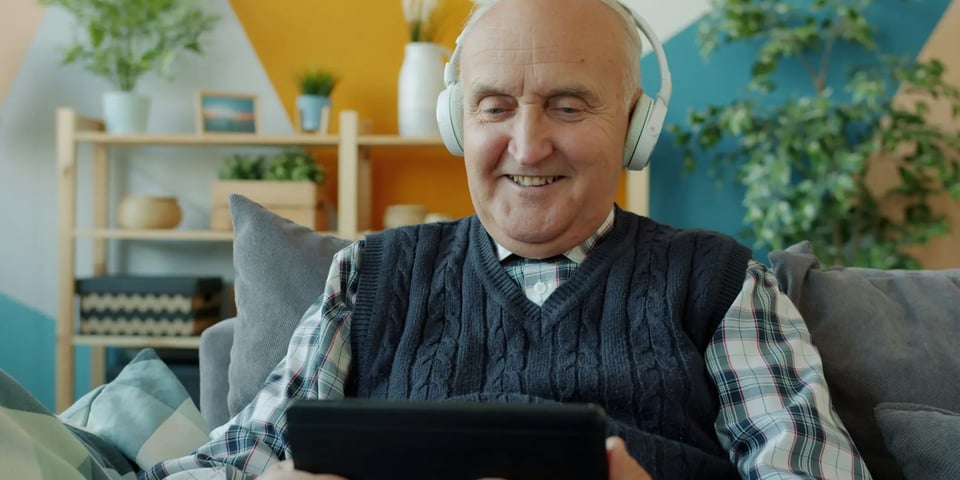
The new study shows that organised exercise at home using digital programmes can be just as effective as rehabilitation with a therapist present in hospital. This gives patients the opportunity to exercise more frequently and at their own pace, in the safety of their own home.
The researchers also found that people who have had a stroke are already active users of technology. For example, they use smartwatches that track activity. Apps for cognitive training, digital games and video consultations with therapists are also widely used.
– We found that many people found the technology useful and motivating in their everyday lives. It can help make exercise more enjoyable and easier to integrate into daily routines, says Hestetun-Mandrup.
Technology must be adapted to the user in order to be successful
At the same time, research emphasises that there is no one-size-fits-all solution.
Many people live with long-term physical or cognitive challenges. Examples include reduced strength in one hand or loss of vision in parts of the visual field. Some people have difficulty concentrating.
This can make even simple technology difficult to master.
It is therefore absolutely crucial that solutions are developed with in-depth knowledge of users’ actual needs and circumstances, the researcher points out.
“Digital tools have enormous potential. But they must be purpose-built if they are to benefit as many people as possible,” she says.
She emphasises that technology should never replace valuable human contact with healthcare professionals.
The aim is for it to act as a supplement. Technology can be a tool that supports patients in their daily lives between face-to-face appointments with healthcare professionals.
Virtual reality tested for rehabilitation
Virtual reality (VR) was also tested as a potential tool in rehabilitation.
Participants were given the opportunity to practise everyday tasks. These included cooking in a virtual kitchen or reaching for objects. All took place in a safe and controlled digital environment.
For many, this provided an opportunity to practise without fear of failure or injury. The experience was described as motivating, engaging and surprisingly realistic.
Nevertheless, the study showed that current VR solutions require further development. They need to be made easier to use and better adapted so that they can be used safely and effectively at home without direct supervision, according to the researcher.
Hestetun-Mandrup concludes that the potential for technology in post-stroke rehabilitation is considerable.
Success, however, depends on one crucial factor: collaboration.
Future solutions must be developed through close collaboration between patients, relatives, healthcare professionals and technologists, she points out.
This text has been translated with the use of DeepL Translator. The text has been quality assured by OsloMet.
References
- Ann Marie Hestetun-Mandrup et al.: Effectiveness of digital home rehabilitation and supervision for stroke survivors: A systematic review and meta-analysis. Digital health, 2024 (journals.sagepub.com)
- Ann Marie Hestetun-Mandrup et al.: Exploring people with stroke’s perceptions of digital technologies in post-stroke rehabilitation – a qualitative study. Disability and Rehabilitation, 2024 (tandfonline.com)
- Ann Marie Hestetun-Mandrup et al.: Exploring the Influence of Digitalization on Multidisciplinary Poststroke Rehabilitation Practice: Qualitative Study. JMIR Rehabil Assist Technol, 2026 (rehab.jmir.org)
- Ann Marie Hestetun-Mandrup et al.: Challenges and Benefits of Virtual Reality in Home-Based Poststroke Rehabilitation: Co-Design Qualitative Study. JMIR Hum Factors, 2026 (humanfactors.jmir.org)