Created by potrace 1.11, written by Peter Selinger 2001-2013
NO
Search oslomet.no
  • About OsloMet
  • Study at OsloMet
  • Our research
  • Work for us
  • Alumni
  • University Library
  • Contact us
  1. OsloMet
  2. ...Intermediate levels are hidden
  3. Research news
  4. Mental health problems widespread among Ukrainian refugees

Mental health problems widespread among Ukrainian refugees

65 percent of Ukrainian refugees in Norway experience mental health challenges. Women and younger people are particularly at risk.
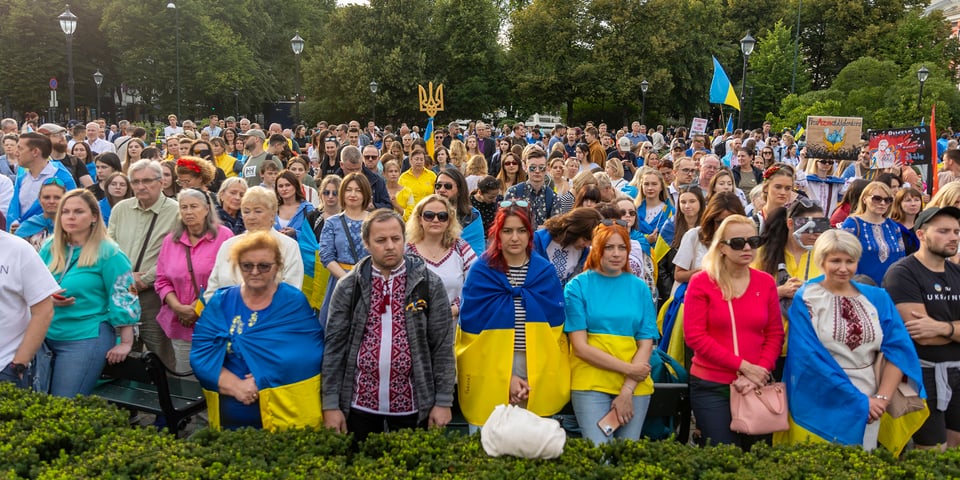
an assembly of Ukrainian refugees wraped in the Ukrainian flag and looking sad and sombre
Photo: Frederik Ringnes/NTB

Forskningsartikkel av: Norwegian Institute for Urban and Regional Research (NIBR)

Publisert: 21.01.2026Sist oppdatert: 12.11.2026
Tone Celine Sundseth Thorgrimsen

65 percent of Ukrainians in Norway report experiencing mental health challenges.

“A very large share of Ukrainian refugees in Norway struggle with mental health problems. The share is significantly higher among refugees than in the Norwegian population overall,” says Vilde Hernes, senior researcher at the Norwegian Institute for Urban and Regional Research (NIBR) at OsloMet.

This is documented in the fourth annual survey of Ukrainian refugees’ experiences in Norway (nva.sikt.no), which NIBR prepares on behalf of the Directorate of Integration and Diversity (IMDi).

“Among the most commonly reported causes of mental health problems are uncertainty about employment, unsuccessful attempts to find work, or jobs where they cannot use their skills. In addition, a general sense of uncertainty about the future creates mental distress,” Hernes says.

Worsening problems over time

Women and younger adults report more mental health problems than men and older adults. Family circumstances in Ukraine also affect mental health.

“Those who do not have close family in Ukraine have better mental health than those who still do,” Hernes says.

Economics also play a role.

“A better financial situation reduces the likelihood of mental health problems, while unemployed individuals and those in the introduction programme are more likely to experience such problems compared to those who are employed,” says Hernes.

The number of years spent in Norway also appears to influence mental health.

“Those who arrived before 2024 report more mental health problems than those who arrived later,” says Hernes.

Those who have close relationships in Norway, however, have better mental health.

“Having specifically Norwegian friends does not appear to matter. What seems most important is having a general feeling of being welcomed and having close connections here,” Hernes says.

Only 28 percent of respondents say they have needed psychological services in Norway, and roughly half of these have received such services.

Teenagers are struggling

“Newly arrived teenagers experience difficulties making new friends, adapting to local schooling, and generally finding their place in the new social environment,” says Hernes.

Researchers have observed the same pattern all four years.

“Another important issue that emerged this year concerns unaccompanied minors from Ukraine – a group that has grown significantly since 2024,” says Hernes.

These are youths who have come to Norway alone, without their parents. Many did not come because they wanted to, but because they were sent away to avoid being drafted by the Ukrainian army.

“This group feels lonely, lacks social connections, and is not interested in the world around them. This often leads to depression and other psychological challenges. Continued research on these young refugees in Norway is essential,” Hernes says.

Contact

  • Vilde Hernes

    Vilde Hernes

    • Research professor
    • +47 672 36 704

Featured research

  • Ukrainians gathered in front of the Norwegian Palace, many have Ukrainian flags in celebration of the Ukrainian independence day. The palace is visible in the background.
    • Working life, society and welfare
    • Cities, regions and urban life

    Only 1 in 10 Ukrainians want to return

    Very few Ukrainian refugees say they want to return to Ukraine when the war ends. Half of them wish to stay in Norway permanently.

  • a woman in front of a computer, with her knees drawn up in front of her and looking sad and desolate
    • Working life, society and welfare
    • Cities, regions and urban life

    Municipalities need more staff. Ukrainian refugees need jobs. So why aren’t more of them being hired?

    “Municipalities are perceived as more demanding and rigid than employers in the private sector,” says researcher Trine Myrvold at OsloMet.

  • Two individuals stand in front of a wooden house holding a large Norwegian flag. The house has three windows and a door visible, with the individuals standing on a small stone pathway leading to the entrance. The background shows some snow and trees.
    • Working life, society and welfare
    • Cities, regions and urban life

    Ukrainian refugees who stayed with private hosts integrated faster into Norwegian society

    A new OsloMet report shows that Ukrainian refugees who stayed with private hosts integrated faster, allowing municipalities to support more people.

  • A panoramic view of the sea of people who participated in the support rally for Ukraine in front of the Storting on February 24, 2025
    • Cities, regions and urban life

    Rising concern for capacity-overload in Norwegian municipalities

    “Record-high immigration and new restrictions aimed at making Norway less attractive to people fleeing their countries.” This is how a new OsloMet report summarizes the key developments in the field of immigration.

  • Close-up of a girls face, painted with a map of the European continent, and with striking eyes.
    • Working life, society and welfare
    • Cities, regions and urban life

    Europe move toward more restrictive, selective and temporary refugee policies

    Over the past decade, European countries have grown more restrictive in whom they grant protection, and for how long that protection is granted.

More featured researched

Forskningsartikkel av: Norwegian Institute for Urban and Regional Research (NIBR)

Publisert: 21.01.2026Sist oppdatert: 12.11.2026
Tone Celine Sundseth Thorgrimsen

OSLO METROPOLITAN UNIVERSITY
STORBYUNIVERSITETET

P.O. Box 4, St. Olavs plass
NO-0130 Oslo
Norway
Tel.: +47 67 23 50 00

Contact us

  • Facebook
  • LinkedIn
  • Instagram
  • Norwegian
  • Accessibility statement
  • Cookies policy
  • Employee directory
  • Employee website
  • Student website
  • Upcoming events
  • Work for us

Short summary

  • 65% of Ukrainian refugees in Norway report mental health problems, mainly linked to uncertainty about work, finances, and the future. Women and younger adults are the most affected.
  • Conditions in the home country and time spent in Norway influence mental health. Those who still have close family in Ukraine or who arrived before 2024 report more problems, while better finances and close relationships in Norway offer protection.
  • Children and young people struggle the most. Newly arrived teenagers and a growing group of unaccompanied minors experience loneliness, adjustment difficulties, and elevated risk of other mental health challenges.

Parts of this summary were generated using Copilot. The text has been quality-assured by OsloMet.

Unaccompanied minors from Ukraine feel lonely, lack social connections, and are not interested in the world around them. This often leads to depression and other psychological challenges.

Vilde Hernes